Useful Resources
Healthy Back Tips
Simple, practical advice to support your spinal health and overall wellbeing
Exercise regularly
Movement doesn't have to be intense to be effective. Even a simple daily walk can have a significant positive impact on your overall health.
Eat a healthy, balanced diet
Proper nutrition supports your body's natural ability to heal and repair. Choose organic, unprocessed foods where possible and drink at least eight glasses of pure water each day. Minimise or avoid recreational drugs, prescription overuse, alcohol and caffeine.
Maintain good posture
Be mindful of how you sit and stand. Ask yourself right now: Are you sitting up straight as you read this?
Sleep on your back or side, not your stomach
Sleeping on your stomach can twist your neck and strain your spine. Avoid the curled-up fetal position, as it reverses natural spinal curves.
Invest in quality support
A good chair, pillow and mattress are essential. Considering how much time you spend using them each day, they are well worth the investment.
Stretch before and after sports
Loosening the spine and surrounding muscles helps prevent injury and improves performance.
Take movement breaks
If you sit for long periods, whether at a desk or in a car, stretch your legs and back every hour. Regular movement keeps muscles from tightening and reduces injury risk.
Avoid cradling the phone between your neck and shoulder
This places unnecessary strain on the neck and upper back.
Lighten your load
Avoid overloading backpacks, purses or bags, and try to carry them over both shoulders to balance the weight. Keep your wallet out of your back pocket when sitting, especially while driving, to avoid spinal imbalance.
Visit your chiropractor regularly
Particularly if you are experiencing stress, illness, pregnancy or have been involved in an accident or trauma. Preventing a problem is always easier than correcting one.
Nerve Chart
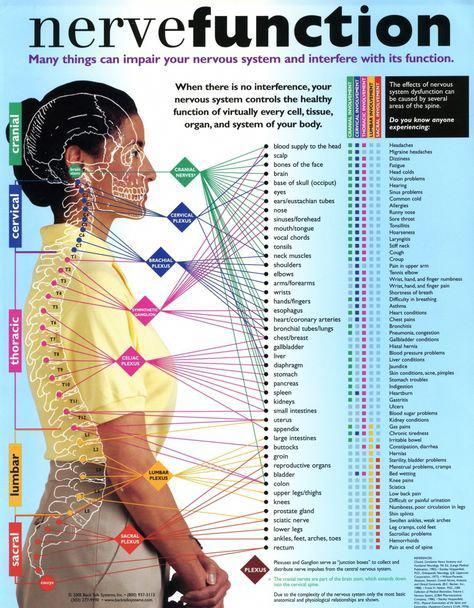
Your nervous system controls and coordinates every function of your body and allows you to adapt, respond and thrive in your environment. A major portion of this system runs through your spine. The spinal cord acts as the main communication cable extending from your brain, travelling through your spinal column and branching into spinal nerves at different levels.
These spinal nerves exit between the vertebrae and supply every organ, muscle and tissue in your body. For your body to function at its best, your nervous system must work without interference, and this includes ensuring the spine remains properly aligned and moving well.
When subluxations occur, they can disrupt nerve communication at any point where nerves exit the spine. This interference may alter the normal function of the areas those nerves supply, which can ultimately affect your overall health.
The Interactive Nerve Chart is designed to illustrate some of the key relationships between different parts of the spine and the nervous system. It is important to remember that the nervous system is far more complex than any chart can fully represent, but this tool provides a helpful visual introduction to how spinal health and nerve function are closely connected.
Frequently Asked Questions
Click on any question to reveal the answer
Ready to Take Control of Your Health?
Start your journey to better spinal health with expert chiropractic care.